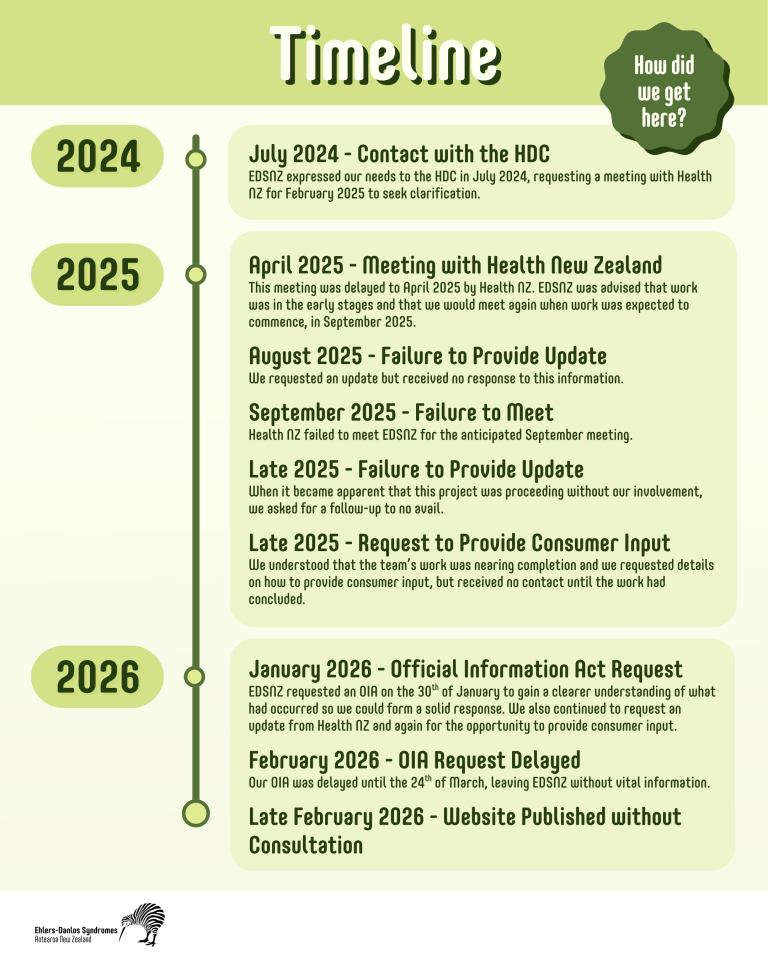
Heath NZ and EDSNZ response to this matter.
EDSNZ Position Statement
Issued by Ehlers-Danlos Syndromes Aotearoa New Zealand
Date: 2 March 2026
Subject: Clarifying Official Guidance on Ehlers-Danlos Syndromes (EDS) and Hypermobility Spectrum Disorders (HSD)
Background:
In February 2026, Te Whatu Ora (Health NZ) updated its public health information on EDS and HSD on its official website. This was followed by a news report from RNZ in which patients and advocacy groups described the guidance as “incredibly damaging.” (RNZ)
Our Position:
- We support evidence-based information about EDS and HSD.
EDS is a group of heritable connective tissue disorders with recognised genetic causes for most subtypes. hEDS/hypermobility disorders, including HSD, require nuanced clinical understanding reflecting international standards. (Health New Zealand | Te Whatu Ora) - We are concerned about inaccuracies and clinical misrepresentation in the Health NZ information that conflates hEDS with HSD and misstates underlying pathophysiology. (RNZ)
- Clinical expertise matters. We were not consulted in drafting the guidance, nor were internationally recognised EDS experts in New Zealand. (RNZ)
- Patient safety and lived experience are essential to healthcare guidance. Many people with EDS experience complex multisystem involvement and life-long morbidity. Decisions about treatment, referrals, imaging, and multidisciplinary care should not be oversimplified. (RNZ)
- We call for immediate revision of the Health NZ guidance to align with international diagnostic criteria, include full clinical nuance and risk profiles, and to acknowledge patient voice in consultation.
Acknowledgements:
We recognise the strength and persistence of individuals, whānau, caregivers, clinicians, researchers, and support groups nationally and internationally who contribute to improved understanding of EDS and HSD.
Contact for comment:
Kelly McQuinlan – Ehlers-Danlos Syndromes Aotearoa New Zealand
EDSNZ Public FAQ
1. What are Ehlers-Danlos syndromes (EDS)?
EDS are a group of heritable connective tissue disorders that affect collagen and connective tissues throughout the body. Subtypes vary in severity and symptoms, and many have recognised genetic causes.
2. What is hypermobile EDS (hEDS)?
hEDS is the most common form of EDS but, unlike some other types, does not yet have a single identified causal gene. It is still part of the EDS spectrum and involves multisystem connective tissue dysfunction.
3. What is Hypermobility Spectrum Disorder (HSD)?
HSD includes disorders involving symptomatic joint hypermobility that do not meet hEDS criteria. It can involve pain and systemic symptoms but is not classified as one of the inherited EDS subtypes.
4. Are hEDS and HSD genetic?
- Many EDS types are genetic and involve changes affecting collagen.
- hEDS does not have a confirmed genetic marker yet but is included under heritable connective tissue disorders and research is ongoing.
- HSD is diagnosed clinically and may not always involve known genetic changes.
5. Why we’re concerned about the Health NZ guidance:
The published guidance:
∘ Omits the clinically recognised separation between hEDS and HSD.
∘ Suggests hEDS/HSD are not due to connective tissue alteration, which contradicts current classification.
∘ Risks misinforming clinicians and patients, potentially affecting diagnosis, accessing and receiving care.
6. Does EDS only cause joint laxity?
No – EDS can affect connective tissues in skin, organs, blood vessels, and other systems. Pain, fatigue, digestive issues, dysautonomia, and other complications are common.
7. Why is accurate information important?
Misclassification or oversimplification can delay diagnosis, misguide clinical decisions, undermine patient care, and contribute to stigma and poor outcomes.
8. What is EDSNZ doing about it?
• Advocating for updated, evidence-aligned guidance.
• Connecting with clinicians and researchers.
• Supporting patients and whānau via information and community networks.
EDSNZ Timeline – Key Actions & Responses
Date | Event |
2017 | International diagnostic criteria for EDS and HSD established (revised classification). |
2019 | National Clinical pathways created in New Zealand by clinical experts. |
2023 | Global research discussions about EDS and hypermobility conditions continue. |
2024 | Health and Disability Commissioner hui |
Early 2025 | Contact Te Whatu Ora to engage in hui |
Late 2025 | Follow up with Te Whatu Ora to engage in hui |
30 Jan 2026 | Official Information Acts request to Te Whatu Ora, response was extended to 24th March 2026 |
24 Feb 2026 | Te Whatu Ora/Health NZ updates public guidance on EDS and HSD. (Health New Zealand | Te Whatu Ora) |
2 March 2026 | RNZ publishes article labelling official guidance “incredibly damaging.” (RNZ) |
Following RNZ publication | EDSNZ public statement drafted and released. EDSNZ FAQ document was released to support our community and professionals. |
Immediately ongoing | Submissions and formal feedback lodged with Te Whatu Ora and HQSC, requesting temporay removal of these articles until correct consultation has been had.. |
Upcoming | EDSNZ seeks stakeholder roundtables with clinicians and policy makers. |
Future | Review and publication of collaboratively updated EDS/HSD guidance aligned with international standards and clinical nuance. |
In the mean time you’re more than welcome to write a complaint to Health New Zealand on your own personal thoughts about this situation, and if you have a specific medical problem that needs a addressing/review, we always recommend writing to HDC. The more voices we have, the louder we are heard. We have created some templates that may help you with this https://drive.google.com/file/d/1WgAvUb3sTVtSgkCdieZe0ap5TLBfWxlO/view?usp=sharing
Please find attached our response to this matter – https://drive.google.com/file/d/1AZAoyB-iS0i6AkTRM5a485iqqdt-WxOJ/view?usp=sharing
Previous HDC response to initial consultation – https://www.hdc.org.nz/media/xjtlewz2/ehlers-danlos-syndromes.pdf